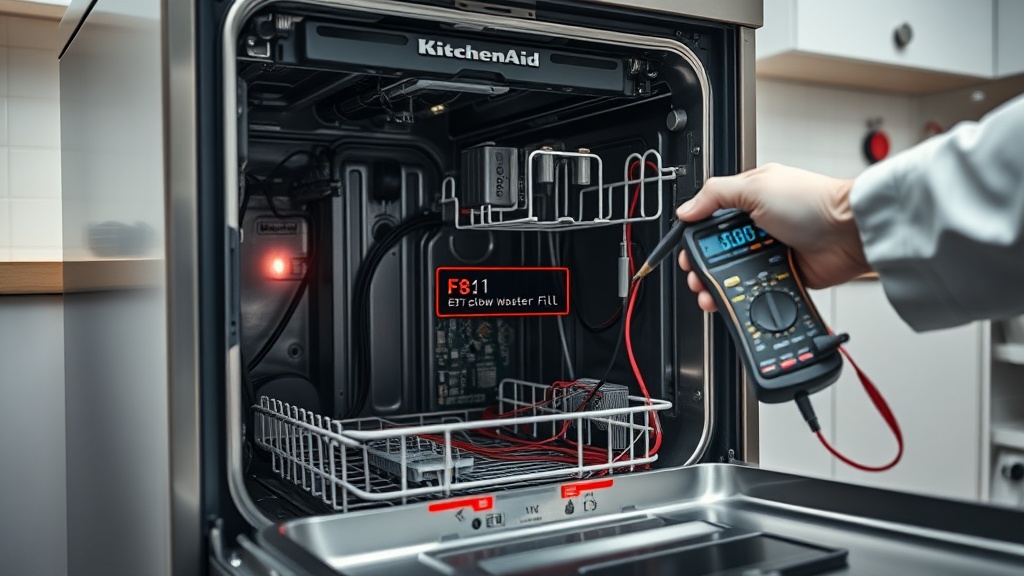
Understanding the KitchenAid Dishwasher F8 E1 Error Fill Issue
Dealing with a KitchenAid Dishwasher F8 E1 Error Fill Issue can be frustrating when your dishes remain dirty after a cycle. This specific error code typically indicates a problem with the water supply or a slow drainage process within the unit.
Understanding the root cause is the first step toward restoring your appliance to peak performance. Most homeowners can resolve this issue without calling a professional by following a few systematic troubleshooting steps.
Common Causes of the F8 E1 Error Code
The F8 E1 (or 8-1) error is primarily triggered when the control board detects that the water level is not dropping fast enough or filling correctly. This can be caused by a blockage in the sump filter or a kinked drain hose under the sink.
Additionally, a closed water supply valve or a clogged air gap can prevent the dishwasher from cycling water properly. In some cases, grease buildup on the pressure sensor may provide false readings to the system.
[IMAGE_PLACEHOLDER]
Step-by-Step Troubleshooting Guide
Follow the table below to systematically diagnose and repair the KitchenAid Dishwasher F8 E1 Error Fill Issue. These steps cover the most common mechanical failures and maintenance requirements.
| Step | Action | Tools Needed |
|---|---|---|
| 1 | Check the water supply valve under the sink to ensure it is fully open. | None |
| 2 | Remove and clean the sump filter at the bottom of the dishwasher tub. | Soft Brush |
| 3 | Inspect the drain hose for kinks and use a drain snake to clear internal clogs. | Drain Snake |
| 4 | Remove the air gap cap on the sink and clear out any accumulated sludge or debris. | Screwdriver |
| 5 | Ensure the drain hose is installed with a “High Loop” to prevent backflow. | Zip Ties/Bracket |
Expert Maintenance Tips for Long-Term Reliability
If the F8 E1 error persists after cleaning the filters, the pressure sensor might be coated in heavy grease. Try running a cleaning cycle with hot water and a specialized dishwasher cleaner to dissolve stubborn residue.
Persistent errors may also indicate a failing drain pump or a faulty water inlet valve. If you hear unusual grinding noises during the drain cycle, it is likely time to inspect the pump impeller for damage.
Recommended Replacement Parts
Disclaimer: This section contains affiliate links. We may earn a commission at no extra cost to you.
Sometimes, cleaning is not enough, and specific components must be replaced to resolve the KitchenAid Dishwasher F8 E1 Error Fill Issue. We recommend using OEM parts to ensure compatibility and longevity.
Key parts to consider include the Water Inlet Valve, the Drain Pump assembly, and the Pressure Sensor. Replacing these components can often save you the cost of a brand-new dishwasher.
FAQ
What is the fastest way to clear the F8 E1 error?
The fastest solution is usually cleaning the sump filter located at the bottom of the tub. Removing food particles allows the water to drain at the correct speed, satisfying the sensor requirements.
Can a clogged garbage disposal cause this error?
Yes, if your dishwasher drains into a garbage disposal, a clog in the disposal or the knockout plug can trigger drainage errors. Ensure your disposal is clear and running properly.
Do I need to reset my dishwasher after the fix?
In most cases, the error will clear itself once a successful cycle is completed. If it remains, you can reset the unit by disconnecting the power at the breaker for one minute.